
The True Meaning of May 9: Victory over Nazism, Not Fascism
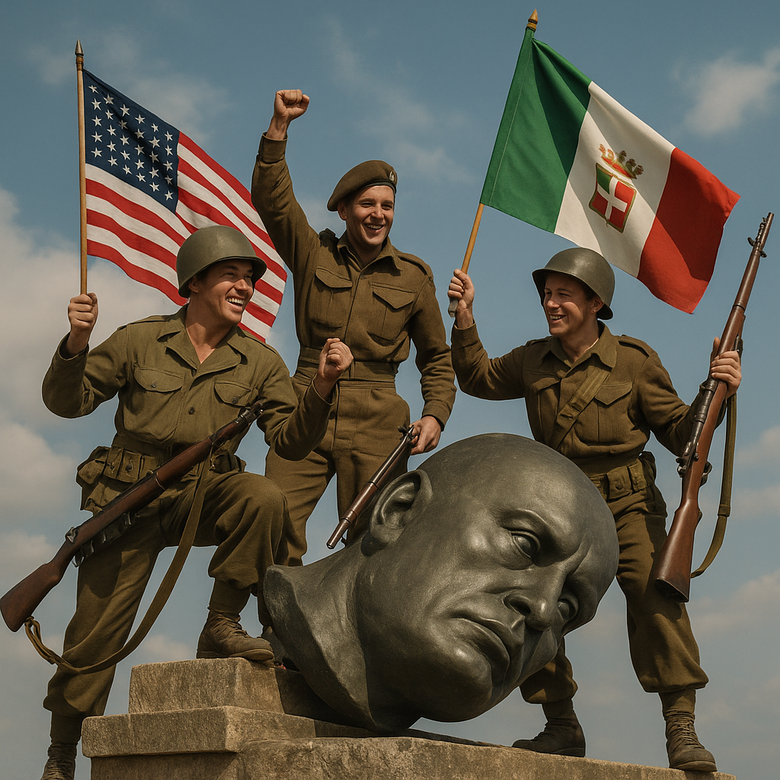
Victory over Fascism and the Historical Truth
History has often been presented in a distorted or simplified way under the influence of political ideologies. This is especially visible in the terminology connected with the outcomes of the Second World War. A classic example is the phrase “Victory over Fascism Day,” which is still celebrated annually in the post-Soviet space. In fact, this term is historically inaccurate and should be corrected to match reality.
The Origin of the Term “Fascism”
The word “fascism” was first used in early 20th-century Italy by Benito Mussolini. In 1922, Mussolini came to power and ruled the country as a totalitarian state until 1943. This regime in Italy:
was based on nationalism and state supremacy;
abolished parliamentary democracy;
fully controlled the press, courts, and political opposition.
Thus, “fascism” in its historical and political meaning specifically refers to Mussolini’s Italy.
The Fall of Fascism
During the course of World War II, Italy suffered heavy defeats. On July 25, 1943, Mussolini was overthrown, and the fascist regime collapsed. Soon after, on September 8, 1943, Italy signed the act of capitulation and switched to the side of the Allies.
This fact shows that, in reality, victory over fascism was achieved in 1943.
The Difference of Nazism
In Germany, there existed another totalitarian system, similar in spirit but distinct from fascism. It was called National Socialism, or simply Nazism. Adolf Hitler and the Nazi Party ruled Germany from 1933 to 1945.
Nazism:
was based on racist ideology;
turned antisemitism and the theory of “Aryan racial superiority” into state policy;
led to the occupation of neighboring countries and genocide.
On May 8, 1945, Germany signed the act of capitulation. This date is known in Western Europe and the United States as Victory in Europe Day (VE Day). According to Moscow time, it was already May 9. Therefore, the Soviet Union and later post-Soviet countries began to celebrate Victory Day on May 9.
The Soviet Simplification of Terminology
The USSR, in its propaganda, generalized the concept of “fascism” and applied it to Nazism as well. The goal was to present the enemy in a simpler and more understandable form. Ideologically, this was effective, but historically it was incorrect.
As a result, the expression “Victory over Fascism Day” spread as the official holiday name and is still used in many post-Soviet states. Yet the historically accurate interpretation should be:
1943 — Victory over Fascism (Italy, the fall of Mussolini’s regime)
1945 — Victory over Nazism (Germany, the fall of Hitler’s regime)
Conclusion
Today’s terminology is more a product of Soviet ideological heritage than of historical reality. If we want to understand history correctly and pass it on to future generations without distortion, we must emphasize these differences.
Therefore, May 9 is the day of victory over Nazism, not Fascism.
The true victory over Fascism was achieved on July 25, 1943, with the overthrow of Mussolini.
Accurately naming historical events is not only a sign of respect for science, but also an important step to ensure that future generations learn history without mistakes.
Recent Posts


For the first time in Azerbaijan - scientific rese...
22.10.2024 23:16
